
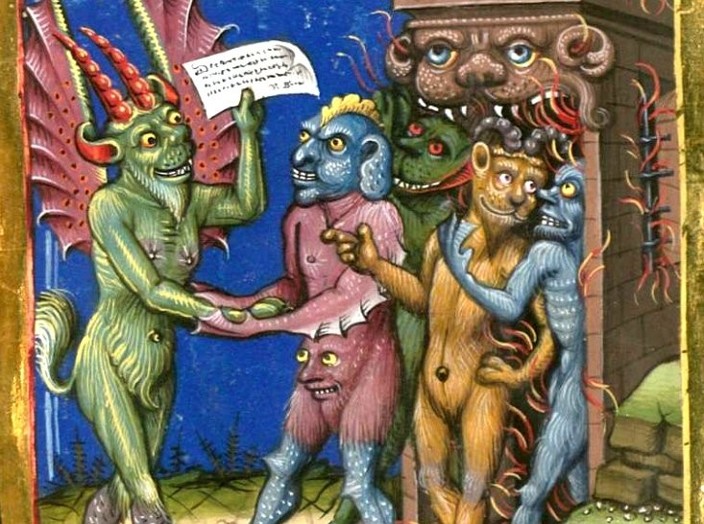
‘Hell is empty, / And all the devils are here’, one of Shakespeare’s characters in The Tempest exclaims during a shipwreck, thereby giving voice to the widespread early modern assumption that supernatural forces, both good and evil, surround us at all times. As legend has it, Martin Luther himself battled the Devil while working on his German Bible translation by throwing an inkwell at him, suggesting a metaphorical link between his Reformation project of making the Bible available in the vernacular and the suppression of demonic forces. In the short run, however, the religious conflicts of the Reformation period only exacerbated obsession with the Devil, as is attested by the early modern witch craze, which led to the persecution of some 90’000 suspected witches throughout Europe and also targeted religious dissenters, who were routinely accused of being Devil-worshippers. Nonetheless, the sixteenth century was a period of profound transition in Christian views of the Devil in the long run. Scepticism reared its head as the Reformation led to fundamental questioning of all religious authority and dogma even beyond Luther’s wildest dreams. A new body of demonological writing identified melancholic delusion and madness, caused by an excess of black bile in the body, as the source of supposed demonic possession and witchcraft, and heretical freethinkers began to entertain the idea that the Devil may be nothing but a metaphor for the evil that is in all of us.
In this seminar, we will trace these evolving views of the Devil in drama, poetry, and non-fictional writing. We will familiarise ourselves with early modern theories of supernatural apparitions by reading excerpts from demonological treatises such as Reginald Scot’s The Discoverie of Witchcraft (1584), before moving on to Christopher Marlowe’s Doctor Faustus (printed 1604), the most canonical early modern play featuring the Devil, which pits orthodox Reformed ideas about evil and damnation against Marlowe’s obsession with radical humanist ideas of human self-empowerment through magic and illicit knowledge. We will further read The Witch of Edmonton (1621), an early modern ‘true crime’ play, so to speak, as it followed hard on the heels of the well-publicised witch trial of Elizabeth Sawyer in 1621. However, despite featuring the Devil in the form of the black dog called ‘Tom’, the play refrains from sensationalist scapegoating. Instead, it offers a nuanced portrayal of Sawyer’s social ostracization, which inspires her desire for revenge through a deal with the Devil in the first place, and embeds it in the thoroughly dysfunctional social life of a village in which just about everyone seems to hide a terrible secret. Moving further into the seventeenth century, we will also consider Milton’s Satan in selected excerpts from Paradise Lost (1667), a searching study of the psychology of evil and without a doubt the single-most influential literary portrait of the Devil in English literature. As the Romantic poet Percy Bysshe Shelley would later put it, ‘As to the Devil, he owes everything to Milton … Milton divested him of sting, hoofs, and horns; clothes him with the sublime grandeur of graceful but tremendous spirit’ (‘On the Devil, and Devils’). Inwardly tortured but heroic, and at times even admirable, Milton’s Satan embodies evil in its most seductive form and fascinated the Romantics as a symbol of courageous resistance to tyranny against all odds at a time when the revolutionary fervour of the French Revolution either degenerated into a reign of terror or, as in the case of Britain, was repressed heavy-handedly by the established authorities. We will therefore conclude the seminar with a brief consideration of the importance of Milton’s Satan for Romanticism and its anti-authoritarian streak in order to gauge the role of early modern representations of the Devil in the development of our modern conceptions of the diabolical.
Learning outcomes: On completion of the course, students will have practised their close reading skills and have become familiar with early modern thought on the Devil and its development throughout the period. They will have gained a thorough understanding of the theological questions raised by God’s seemingly so powerful adversary and insight into how the early moderns made sense of witchcraft. Finally, they will also have reflected on the discursive functions which the figure of the Devil came to occupy in literary reflections on human vice and crime over the early modern period and the challenges of staging the supernatural on the early modern stage.
Bibliography: Students are expected to acquire a copy of the following plays in the course of the semester (the following editions are recommended, but alternative critical editions, if students already own one, are acceptable as well):
· Christopher Marlowe, Doctor Faustus, ed. Paul Menzer, New Mermaids, London: Methuen Drama, 2019. (If you use a different edition, make sure that it is based on the A-text, as the play survives in two significantly different versions, the so-called A- and B-text.)
· Thomas Dekker, John Ford, and William Rowley, The Witch of Edmonton, ed. Lucy Munro, Arden Early Modern Drama, London: Bloomsbury, 2017.
All other texts will be made available online on Moodle.
- Teacher: Kilian Markus Schindler