
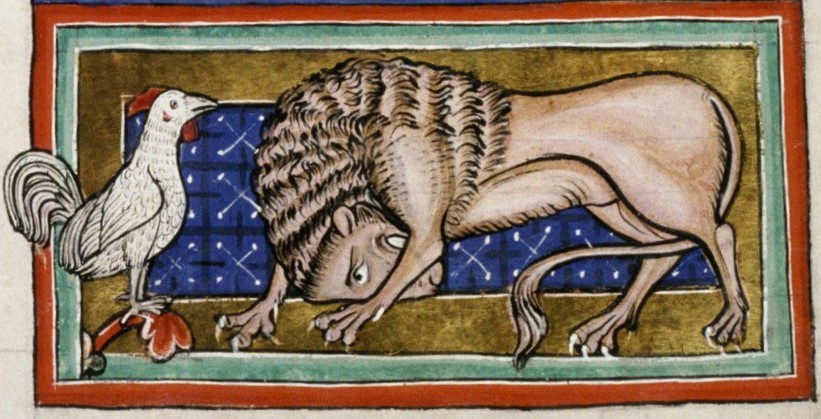
With their cast of talking animals and inanimate objects and their clearly articulated concluding morals, fables are often viewed as stories specifically designed to teach a lesson to an audience of children. However, fables have also been used to offer social commentary or make political arguments intended for adult audiences. Indeed, the flexibility of these tales means that they have been told, retold, and imaginatively reworked to suit a variety of times, places, and situations.
“The shell upon the nut, though hard and tough,
Holds the kernel and is still delightful.
Just so there lies a doctrine of great worth
And fruitfulness beneath a made-up fable.
And scholars say it is most profitable
To mix the merry in with graver matter:
It makes the spirit lift and time go quicker.”
(Seamus Heaney’s translation from Robert Henryson)
In this proseminar, we will focus on fables written by medieval authors including Marie de France, Geoffrey Chaucer, and Robert Henryson, as well as the source material from which these authors draw with an eye for how these stories change over time and in different contexts. This course will explore adaptation theory and creative-critical work through hands-on applications of these theoretical approaches. Course evaluation will include class participation, a short oral presentation, and an essay written in MLA style.
- Enseignant·e: Kristen Haas Curtis