
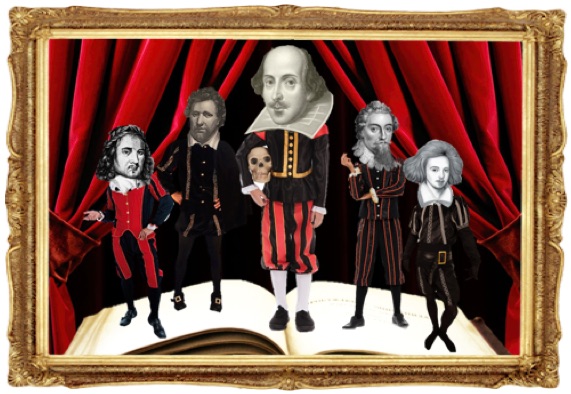
Famously described as ‘not of an age, but for all time’ in Ben Jonson’s prefatory poem to the first edition of Shakespeare’s collected plays (1623), Shakespeare is undisputably the towering figure of English Renaissance literature. He dominates anglophone theatre programmes and university syllabi alike, to the extent that even theatre-goers and students intimately familiar with his work would be hard-pressed to name more than a handful of his literary contemporaries. However, even though Shakespeare’s place at the heart of the English literary canon may seem to eclipse his contemporaries, scholarship from recent decades has amply demonstrated that he did not work in isolation, but that he read the work of his contemporaries attentively and was read by them in turn. And his relations with fellow-writers were by no means always frictionless: the first prominent literary reference to Shakespeare in his own lifetime notoriously accuses him of plagiarism and arrogance, describing him as an ‘upstart Crow, beautified with our feathers, that with his Tygers hart wrapt in a Players hyde, supposes he is as well able to bombast out a blanke verse as the best of you: and being an absolute Iohannes fac totum [jack of all trades], is in his owne conceit the onely Shake-scene in a countrey’ (Robert Greene, Groats-Worth of Wit, 1592).
This proseminar will offer an introduction to Shakespeare’s authorship that highlights his embeddedness in early modern literary contexts. In particular, we will consider how his relations with his rivals shaped his (as well as their) writing practices and self-fashioning as authors. The seminar will introduce students to critical key concepts concerning literary authorship and apply them to various shorter texts and excerpts by Shakespeare’s contemporaries, before moving to more substantial works by Shakespeare. These will include a selection of Shakespeare’s sonnets, in which authorial rivalry is written into the very plot of the poems in the person of the ‘Rival Poet’ – who, to make matters even worse, also competes for the attention of the speaker’s love interest. We will then turn to drama with Shakespeare’s Henry IV, Part 1 (c. 1597), one of Shakespeare’s most popular plays to this day. Its popularity is mostly due to the brilliantly funny Falstaff, a cowardly but quick-witted, old knight-turned-thief, who acts as a (highly dubious) father figure to the rebellious Prince Hal, the successor to the throne of England. While Falstaff is frequently seen as one Shakespeare’s greatest comic inventions, the character was, in fact, based on an early (proto-)Protestant martyr, John Oldcastle, who was executed for heresy and treason in 1417, but celebrated by sixteenth-century Protestants as a forerunner of their own faith. Catholics, on the other hand, continued to condemn him as a heretic and traitor. This debate also played out in the literary world, as Shakespeare’s rather irreverent take on Oldcastle was answered by a collective of playwrights in Sir John Oldcastle, Part 1 (1599), who claimed to set the record straight and restored Oldcastle/Falstaff to his former glory as a martyr and hero of English Protestantism. By placing Falstaff in such literary (as well as religious) rivalries, we will trace how Shakespeare reacted to his predecessors and at the same time stimulated his rivals, who claimed to refute his Henry IV, Part 1 on moral and religious grounds – even as they capitalised on its popularity in order to market their own play.
In order to gain credit, regular attendance and active participation in class discussions are mandatory. (More than two unexcused absences disqualify students from gaining credit.) Students are expected write a seminar paper at the end of the semester.
Learning outcomes: On completion of the course, students will have practised their close reading skills and acquired a critical vocabulary to discuss processes of literary rivalry and influence in a self-reflected and theoretically informed manner. They will have obtained a clearer understanding of how rivalry and competition shaped early modern, and particularly Shakespeare’s, authorship, and they will have practiced their academic writing skills and ability to make a scholarly argument in the form of a seminar paper.
Bibliography: Shorter texts will be made available online, but students are expected to acquire a copy of Shakespeare’s Henry IV, Part 1, at the beginning of the semester. The following editions is recommended, but alternative critical editions are acceptable as well:
· William Shakespeare. King Henry IV Part 1. Ed. David Scott Kastan. The Arden Shakespeare. London: Bloomsbury, 2002.
- Enseignant·e: Kilian Markus Schindler